

More important than the answer, is the question…
Why build on the Bitcoin Standard? As with everything about bitcoin, the answer is simple (spoiler: it’s way better for you as a customer in multiple different ways!), but the answer alone doesn’t carry much weight. If someone doesn’t yet understand the problem, what are they supposed to do with the answer?
Before we even get into either those questions or answers, I want to touch on something important.
Do you, as a customer, need to care about the problems of builders?
In an ideal world, businesses should of course handle the problems of businesses and customers should just enjoy the fruits of the labors of those businesses. Of course!
In that ideal world, you shouldn’t, wouldn’t, almost couldn’t care about these problems. Then again, I don’t think that’s true even in an ideal world: this is just a matter of perspective.
Whether in an ideal or non-ideal world, businesses are not magical black boxes that produce results and solve any and all problems for you for a fixed amount of money.
If an existing business works in a certain way, and you take a new problem and toss it into that “black box”, you can’t expect the same end result to come out. Something about the end result will change, if only the price (it’s most often the price).
Businesses are great problem solvers, because the people working in them are heavily incentivized to not sit around wishing for things to get better – if they make things better, they get rewarded for it.
The more problems you add into the process of production (whether products or services), the more complicated things get for people who could otherwise focus all of their time and energy in making life better for you. That might mean that they are less able to improve your life, or have to do so at a higher price.
Dividing problems into “problems of people” and “problems of businesses” is magical thinking: the problems for businesses are problems for the people working in those businesses, and problems for them are problems for the people enjoying the output of those businesses.
You, as a customer, should be on your toes with fiat businesses. The fiat economy produces so many unnecessary problems for the businesses to solve, that those problems are your problems – not in theory in the future, but in the real world now. It is not the fault of the fiat businesses, but it is your problem. You should demand better, and look for businesses built on the Bitcoin Standard!
What are the fiat business problems?
The best way to describe the problem is on two different levels. First there is the bigger underlying problem, and second, the way that bigger problem applies to businesses, especially the kind of business that Sovereign Landing is.
So, what is the big problem? That’s answered perfectly in this great video. I’m so glad Joe made that!
That’s really more of the description of the underlying societal problem though. The problems for businesses are touched there, but it goes farther than that.
What people refer to as “late-stage capitalism”, is a real but misidentified problem: it’s not capitalism that is broken, but problems brought to it by mid-stage socialism and central planning – caused by the broken money, as described in that video. Despite these heavy-handed and severe market disruptions, capitalism is resilient and the wheels do keep turning, but there is heavy friction and things don’t quite work like they should.
What was supposed to be the “promise” of capitalism, is twisted by the market interventions and turned into crony capitalism – and the problems it causes are real.
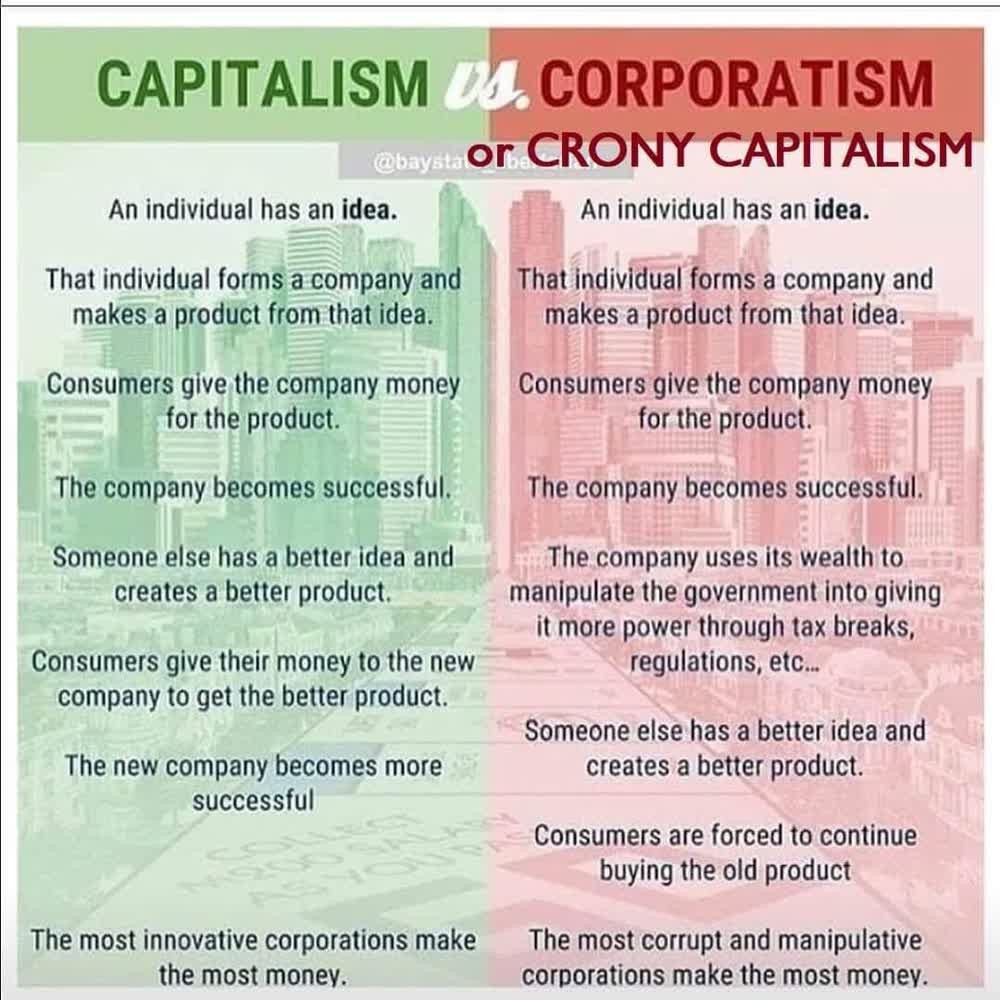
You can feel these problems in your everyday life. In “pure capitalism” (people freely exchanging goods and services on the market), the effects of technological and societal progress would directly impact you and make things more abundant and cheaper. What we experience is the total opposite of this.
These problems also ruin the customer experience with many businesses, especially the large corporations. They don’t really get their profits from the customers, but from playing financial tricks within the fiat system.
To these corporations, the customer is just an unavoidable annoyance that is required to keep their actual profit machinery running. That machinery has nothing to do with building up the society or improving the life of the people, but instead it just enriches the people at the top rungs of the fiat ladder.
Understanding this, it is very easy to relate to the leftists who are angry at the current system. I get it! The problem is that their anger is misdirected, as they don’t understand the source of the problem. It is the money printing, not the “rich” people. Broken money ruins everything it touches, and the more it touches things, the more rotten they get.
Short-term thinking is a plague
When I travel the world, I run into this problem all the time: the fiat economy incentivizes short-term behavior, which translates into people either trying to rip each other off directly, or at least makes them compromise heavily on quality in order to turn a quick profit.
This is especially prevalent in the “travel industry”, where you often don’t have lasting customer relationships, but have people coming and going all the time. If you can get by giving them sub-par quality and still get paid in full, why bother going the extra mile?
As a location independent person, I have to dig myself out of this hole pretty much every time I move. It’s an ongoing battle.
With the current corporate “solutions”, they are looking to maximize quarterly profits with blatant disregard to customer happiness. Those problems go beyond just “not caring” – it seems they have open and brazen contempt for the plight of their customers, and apparently zero interest in improving.
Misapplication of the 80/20 rule, and how to apply it correctly
I’m a huge fan of the 80/20 rule: 80% of the consequences come from 20% of the causes (or 80% of the results come from 20% of the effort). This seems to be an inherent aspect of reality, as it is applicable to so many different things.
It is also possible to misinterpret and misapply it in ways that are destructive, and that is exactly what I see happening in fiat businesses. The corporate management seems to think that if 20% of the effort produces 80% of the results, then they can juice up their quarterly bonuses by cutting out 80% of the efforts and getting huge cost savings!
It doesn’t quite work like that, but they still try so very hard to do just that, because the twisted incentive structures make them only focus on the very short term at the cost of the long term. This flawed thinking then leads to overall degeneration of the customer experience, crapflation being perhaps the most prominent example.
This doesn’t mean that the 80/20 rule should be ignored: it just needs to be interpreted and applied correctly. To do that, you need to understand another principle: Chesterton’s Fence. If you see a fence, you should assume it is there for a reason. If you don’t know why it’s there, that doesn’t mean you should remove it! The same goes for 80% of the efforts: they may just be there to enable the 20% of the efforts to be so productive.
Just as a practical example, spending time in your email inbox isn’t probably doing much to improve your business. That doesn’t mean you should make an executive decision to completely get rid of you email. Yet these businesses are often playing exactly those kinds of games, and if that threatens customer satisfaction, the only thing that counts is the (imaginary) cost saving. Customers, schmucktomers, who cares when the bonuses are on the line…
The correct way then is to focus on not removing the 80%, but on doing more of the 20%. That way, the possible unnecessary things in the 80% become proportionally less impactful, and you’re increasing productivity without accidentally removing any foundational building blocks. The iceberg is not just its visible tip.
That doesn’t mean that you shouldn’t always be on the lookout for removing unnecessary fluff, but blindly applying the 80/20 principle is just dumb. The focus should always stay on the big picture and on what the long term fundamentals of the value creation of your business are!
When you understand that these corporations are fiat corporations through-and-through, none of that should surprise you – these organizations are just responding to their financial incentives, and you as a customer are not really a meaningful consideration in them.
For these corporations, it’s fine to get a customer and rip them off once, because that money goes into their bottom line and fattens up their quarterly bonus. What happens in the following quarters is not at the top of the mind for the executives. To them the idea of spending money on improving the customer experience is just a bad joke, one that can get you fired if you tell it in an executive meeting.
The fiat rot creeps in through banks and VC funding
I’ve written about the problems of banking in the 10.1 Why banks seem to hate customers, and those problems are twice as bad for businesses. Just getting business bank accounts has been a huge struggle all throughout my location independent career, and it’s not getting any easier. There are always solutions, but the question is at what price?
The price isn’t money. It is compliance costs, which require money, but also much more than that.
Especially with a business like Sovereign Landing, where the core of the business is international, the banks are in a very difficult position. While the individuals working for the banks understand very well that this is a legitimate and honest business, they need to prove that to the regulator breathing down their neck – and that’s easier said than done.
That doesn’t mean that it would be impossible to get a bank account and run this business on a fiat standard – after all, fiat money gets transmitted between countries all the time.
The problem is that most of those cross-border transmissions are done by huge corporations with huge accounting departments. They have the resources to deal with banks, and banks have a corresponding incentive to work with those corporations as they can get paid through the hefty fees those corporations can afford to pay them.
For a smaller business, those prospects look bleak. As a non-VC-funded startup, I can’t personally hire a compliance department or promise banks that they can pay their own compliance officers through the money Sovereign Landing would bring in. I can’t make any single local bank any promises on how much money there might be coming or going, or where it’s coming from and where it is going to – it really depends and is fundamentally complicated.
Banks don’t like complicated, and that’s all they see Sovereign Landing as being.
The obvious solution would be to do as many other startups do, and find that VC funding. Money is great after all, and free money from investors is the best thing ever, right?
This is where things look very different for fiat and bitcoin based companies. Fiat money is plentiful. The people with plenty of fiat money have a burning need to put it somewhere with even relatively decent chance of return. Getting fiat funding is not difficult.
The problem isn’t getting the funding. The problem is the strings that fiat money comes attached with – the strings of the fiat economy.
The fiat economy is a machinery for value extraction, not value production. I will write more on this later, but right now I encourage you to read more about this topic in Bitcoin Is Venice – a great book! This short excerpt is relevant here (emphasis in bold, mine):
The customer base of Nike, McDonald’s, or whoever, and the beneficiaries of assets managed by BlackRock, or whoever else, may or may not care about these causes. But this doesn’t matter: This is not a clumsy attempt at marketing. Or rather, it is, but the customer is the tax-collecting state, the operationally-necessary rent-seeking banking cartel, and the social caste of narcissists that populate both ranks, rotating amongst roles, and from which the decision-makers wish not to be excommunicated. It is very much not individual consumers or savers.
This is perhaps the cleanest way of describing how the merchant strikes back. Much of her financial necessities and actions will be entirely within her own control. She will return to a state of having only one customer: the customer.
That is the reason why problems of the builders are, inescapably, the problems of the customer.
The businesses in the fiat economy are first built on a promise of value for the customers, only to then be hollowed out of that value after they have the customers “trapped” – and in many business, getting out of those traps is a genuine struggle. This is what happens all the time, with Adobe being of the latest victims, but it’s far from being the only one, as described in this tweet:
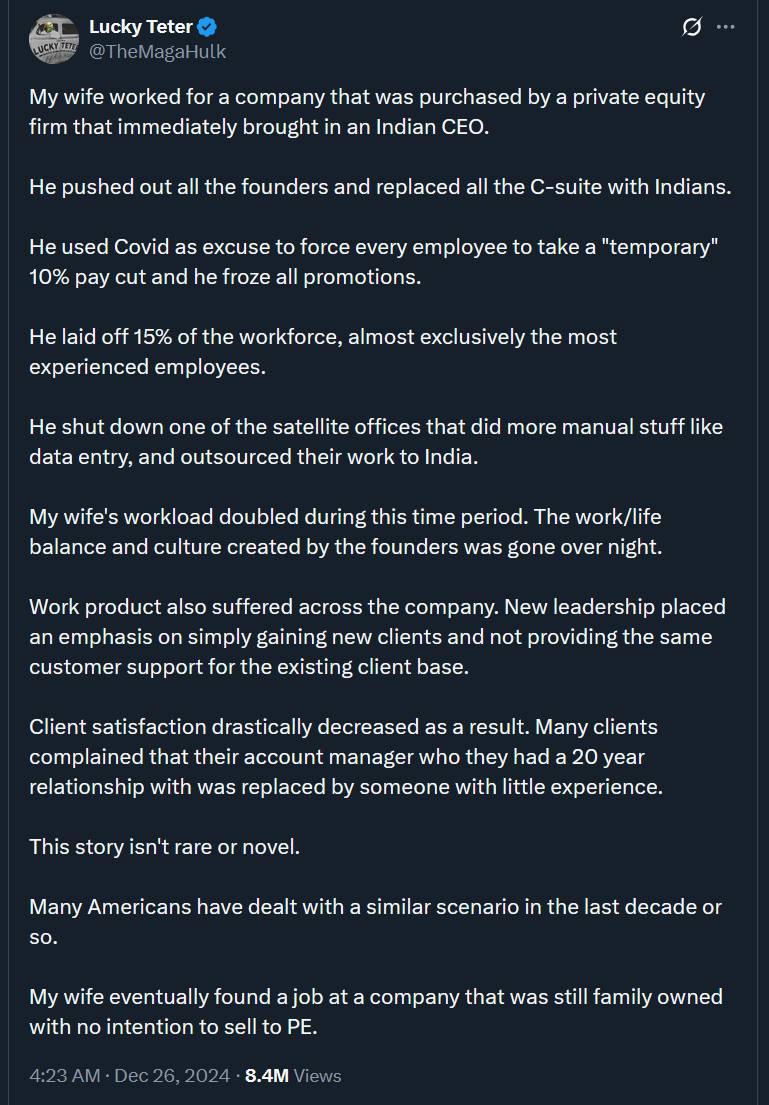
In that post, in accordance with the MAGA us-vs-them narrative, the blame is placed on the Indian CEO. I don’t believe this has anything to do with nationality. That “Indian CEO” was just doing what is taught in all fiat business schools, and what the fiat shareholders expect from him. It is just what the fiat economy incentivizes every person and every business to do: to have a laser focus on the short-term with no regard to the long-term.
There is no free money, even with fiat VC funding – sooner or later, forced foregoing of the long-term value would be the price of that money. In the short term, the company would have the “luxury” of focusing on the eternal principles of basic economics and creating real value for real people, with the focus being on the customer experience and profits made with (not from!) perpetually happy customers. Even the fiat people understand that the money should come from lasting customer relationships: people who stay as customers for years or even decades.
That fact does get soon forgotten though. The fiat incentives push the VC funders to demand bigger profits faster, at the expense of the “80%” that on the first glance doesn’t seem to be producing quick results. This short term foolishness then starts hollowing out the core value proposition of the business, resulting in just the “once great, now empty” brand that can then be passed on to the greater fool in the fiat marketplace.
One of the main drivers of human motivation is the eternal pursuit of mastery – the endless striving to be better than you were yesterday. I think a lot of the fiat economy is the opposite of this, and the very reason why so many people working in corporate settings are so burned out. They are extracting value and making life worse for the customers of the businesses they are silently destroying – and I’m 100% sure the meaning (or lack of it) of their work doesn’t escape them. They are actively making the world worse, which is the very opposite of mastery. I don’t see a point in building a business with even a small risk of that happening.
A business should never force ideological choices on customers
Even with everything said above, I’m not categorically opposed to fiat payments and banks, but I am categorically opposed to these “side effects” that world would bring. As long as no clear solution can be found, Sovereign Landing will work on a bitcoin basis only – but that doesn’t mean that fiat payments are completely ruled out!
In an optimal world, businesses should go with what the customers want – and I’m sure many customers would consider credit card payments as an obvious basic requirement. That’s why this isn’t a categorical “ruling” that we would push for the customers. You will be always working directly with the individual local agents and landlords, and if they can accept credit card or any other payments, then that’s great!
The regulatory hurdles they have to pass are several orders of magnitude less, as they are simple local businesses and service providers that are easy to understand for the regulator. Sovereign Landing is a decentralized business, with decentralized solutions – if you can pay with decentralized money, that’s probably easiest for everyone, but if not, we will do our best to accommodate your chosen method of payment (but, for reasons described above, can’t make promises beyond bitcoin).
This division between the “online coordinator” that is Sovereign Landing, and the local service providers, results in a system that has both regulatory clarity (on the local level where it’s required) and resistance to government disruptions that, unfortunately, can’t be ruled out in the world we live in.
Covid madness taught me an important lesson about resilience to government-induced madness, as my memories of the years 2020-2022 are a bit hazy. The stress of owning a business with strong ties to the physical economy was a bit much, and I didn’t even personally suffer the worst of that attack – I survived, as did that business (luck did play a role). The business manager I had hired survived, barely, by suffering through stress I wouldn’t wish on anyone. I still feel bad about those times. It was an impossible situation – never again!
Having this kind of a dual structure should allow for Sovereign Landing to be highly resistant and agile even if some local governments decide to become actively hostile (those are just really tiny examples in a sea of hostility towards businesses, and it’s not really important which specific countries this happens in).
Constructing the business this way, and leveraging the power of bitcoin, isn’t (just) an ideological stance – unfortunately the hostility towards both businesses and productive individuals is clearly on the rise, and just ignoring that and hoping for the best could be extremely bad for this (and any other) business. The exception are the large corporations, that can pay to interface directly with the state, and therefore benefit from the bureaucratic machinery – it is the small and medium businesses that are on the firing line.
It is possible to bring back quality and true value
None of the fiat problems described here have to be this way. They can be fixed by building a business that opts out of the rotting effect of the fiat system (fiat VC funding is not welcome here!) and instead focuses on the eternal principles of basic economics and the beauty of free market: creating real value for real people, with the focus being on the customer experience and profits made with (not from!) perpetually happy customers. The real money comes from lasting customer relationships: people who stay as our customers for years or even decades.
That is the essence of operating on high future preference!
Getting a customer and then ripping them off once has nothing to do with running a good business. That sounds obvious, but it is completely non-obvious to people deep inside the fiat corporations. For a business build on a Bitcoin Standard, there are no other alternatives. The money comes from customers, not from financial shenanigans or anywhere else. On top of that, it’s not enough to get a customer – you as a customer need to be happy, happy enough to keep using our service indefinitely!
To do that, we need to incentivize people to look at things from a longer term perspective, and forget about short-term shenanigans and finding ways to get “one-ups” on their customers.
Currently, the whole world is so deeply bathed in the corruption of the fiat economy that at first, the above idea may sound laughably naive and impossible. However, I think it’s totally possible to do just that, and “changing the whole world” isn’t a pre-requisite for getting started.
The way to start is just to open the minds of especially the landlords to pay more attention to quality – what quality actually means in practice, and how focusing on it can pay off for them! This is mostly education and communication. The landlords often live a very different life from us location independent people, and they just genuinely don’t understand our needs – but that’s not hard to fix.
Sovereign Landing can, and does, build systems that are easy, and profitable, for the landlords to follow. Instead of arriving in either extremely overpriced or sub-quality temporary accommodations, we can make sure that things are there ready for you, and you don’t have to fight with people who are trying to take advantage of you. You can arrive in a place you’ve never been to, already set up like it was your home!
This way, Sovereign Landing can shift the perspective of the service providers from short-term fiat money grabs to true value creation!
This is much more than just about finding you some random accommodation: the real value is in making sure that that accommodation is both fairly priced and well-equipped with quality items, so that you can just arrive and thrive!
Unlike the common daily rental platforms, we have active quality assurance systems in place to make sure you never have a bad experience. However, as reality is messy and it would be a bad idea to design systems to work only when everything goes as planned, the “edge cases” need to be considered. In case our quality assurance systems fail, we have the quality guarantee in place that enables you an easy exit from the deals in case you’re not happy for some reason.
This keeps everyone honest, and is a night and day difference to the existing solutions, where they do everything to grab your money once, and then keep it no matter what happens after. Those money grabs may seem worth it for people whose primary interest is their quarterly bonus, when businesses should be much more interested in long-term customer satisfaction, even if it comes at the expense of short-term profits.
What all of this boils down to is this: building on the Bitcoin Standard allows us to focus fully on service quality and optimizing for the best possible customer experience. You are the only master we serve!