

Hidden violence behind every political decision
There’s an inherent problem with all politics – while politics may have started off as a means to avoid violence, it has never been able to shed this connection to violence. Carl von Clausewitz said that “war is merely the continuation of politics by other means”.
If you look at this from a slightly different perspective, you can’t help but notice that behind all politics, violence is always hidden. The inherent idea with all political decisions is to force others to act as the political decisionmakers wish, whether people like it or not – or ultimately face violence if they resist.
This violence is always disguised and extremely rarely openly discussed, but it is always there. Things that are decided within the domain of politics, always carry with them this silent threat of “…or else!” – “else” meaning different levels of employing (or just threatening to employ) the state machinery of violence, which should be reserved only for criminals.
Therefore, when politics gains increased ground, even non-criminals face an increasing threat from this machinery – or put another way: their sphere of free action is made ever smaller. This is the most evident with most types of otherwise normal economic actions, which increasingly become either illegal (regulated to death) or unprofitable.
Whenever this “machinery of violence” is mentioned, I do feel the need to also mention that we shouldn’t be naive about violence in general – if you want peace, prepare for war, etc – and at the same time, I’m fully aware of the issues brought about by this hidden violence, which is so deeply embedded within the structures of our current societies.
When “everything becomes political” (more or less the current situation with legacy countries!), it means that nothing gets solved by peaceful and voluntary means. Everything depends on the state, and requires the state to force people to act in ways it sees fit. Just because that violence may be well-hidden, doesn’t mean it’s not there!
If the problem(s) with that are not obvious to you, please look to the Soviet Union, and for counter-arguments, look to the countries in the past that have at least tried to be something opposite of what the Soviet Union was. Even if you don’t feel that the disguised violence is a moral problem, it is very much an economic problem – regardless of what anyone feels.
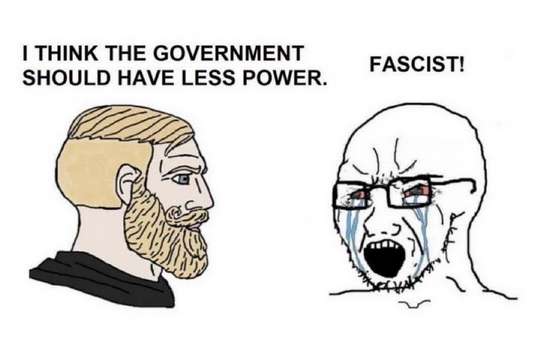
Communists like to call other people fascists, which is funny because fascism and communism are extremely similar: both require the state to have all power!
This economic problem is ultimately what causes democracy to become such a huge problem for societies.
How the democratic black holes were formed
The pull of the black hole starts quietly and slowly through people statistically at the bottom of the society:
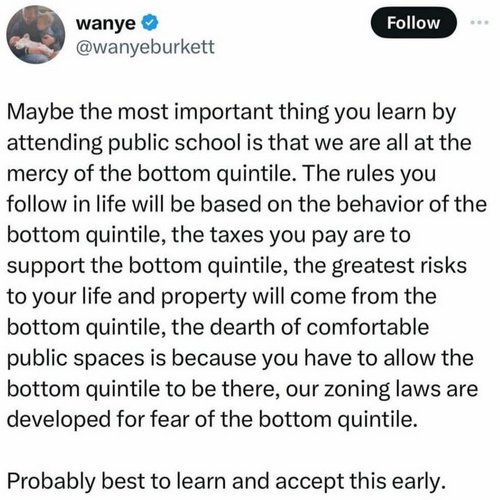
I can easily accept that to be true for countries I don’t want to live in. Societies don’t have to be like that.
When everyone has one vote, you might expect democratic societies to stay in balance: at least the idea is that different people have different views on what the optimum state of society is, and it evens out so that everyone is more or less ok with the situation. In practice, that’s a short-term view at best. Unfortunately the long term becomes a huge problem through a few different mechanisms: